
Your rehab doesn’t happen on Zoom.
It happens when you train.
Your video calls are part of the process. But most of the magic happens between them: while you train, report back, and your physical therapist reviews, responds, and adjusts what comes next.
How care works, start to finish.
A live evaluation, one-to-one
Meet with your physical therapist on video to make sense of what’s been going on, what you’ve tried, and what you’re trying to get back to. Together, we’ll define what “done” means to you and outline the process to get there.
Find your entry points
The evaluation gives us a clear starting point. Your first few weeks of training show us your foundation — the movements, loads, and training volume we can confidently build from.
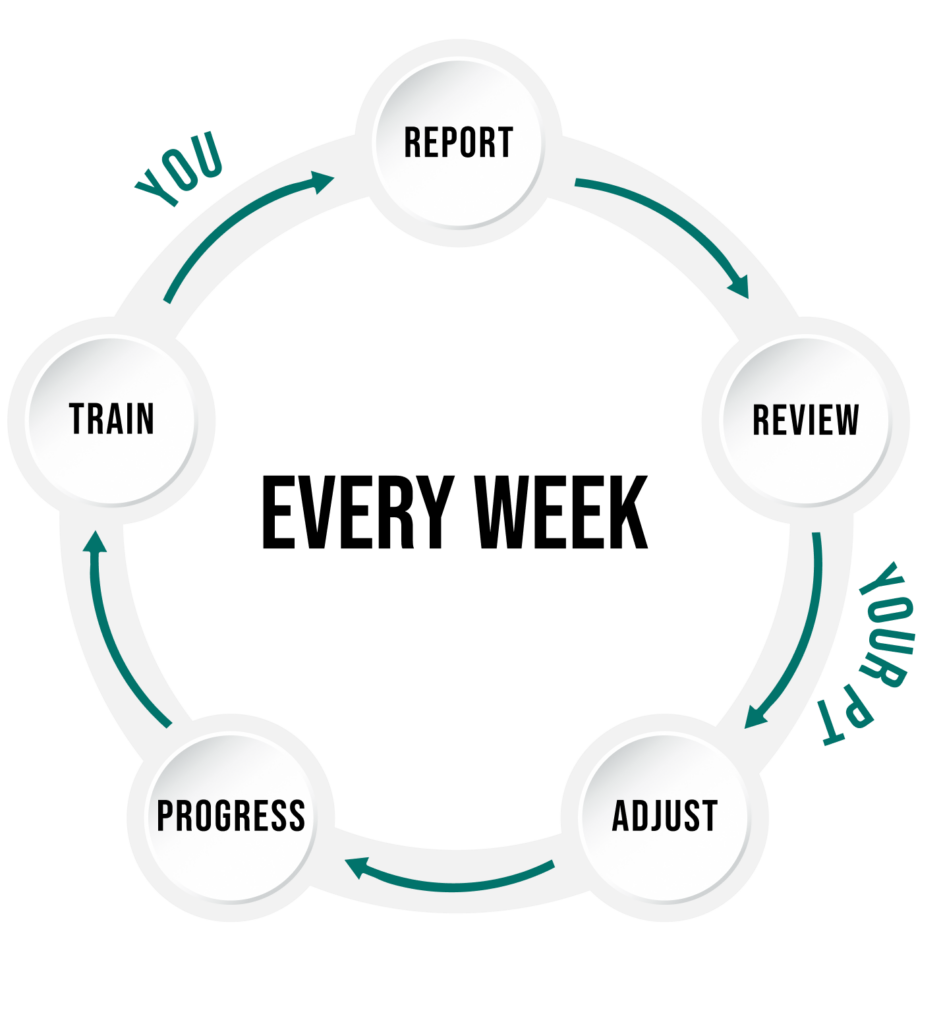
Train + Report
Do the work. Tell us what happened. Your plan lives in the app, but the rehab happens where you train: at home, in the gym, on your route, or on the court. Log what you did, how it felt, and anything your PT needs to see.
Review + Adjust
Your PT takes it from there. Throughout the week, they review your training, symptoms, notes, and video. They give feedback, answer your questions, and ask their own. It’s an ongoing conversation about how you’re responding and what happens next. You’ll also have scheduled video calls to step back and plan ahead, with additional calls when they’re useful.
Progress
Build from where you are toward where you need to be. This isn’t a six-week program we hand you on day one. Your rehab progresses based on what the goal requires and how you’re responding along the way. Sometimes that means moving into the next phase. Sometimes it means building the foundation for what’s next.
Done.
“Done” means you can do the thing we defined together at the start. You’ll leave with a clear understanding of what comes next, whether that’s returning fully to your sport, continuing to train independently, or moving into performance work.
No arbitrary finish line. Just an honest one.
Meet Molly.
Here’s what working with Clinical Athlete actually looks like: from figuring out where Molly needed to start to the work that happened between calls.
A common case, not one athlete.
Your care team.
You’ll work one-to-one with a physical therapist who knows your case, guides your rehab, and stays in your corner from evaluation through done. They’re backed by a team built to support the work around them.
Your physical therapist
Your main guide, in your corner from evaluation through done. They run your evaluation, build your plan, review your training throughout the week, answer your questions, and adjust what comes next. When it matters, they coordinate with your coach, your surgeon, or anyone else involved in your care.
Your team lead
Think of them like the athletic director for your team. They set the standard the team works to, support your physical therapist, and bring another layer of expertise to the care happening across the team.
Your care coordinator
Your point person outside the rehab itself. They’re the first person you meet, help get you to the right team, and stay involved with scheduling, billing, and the logistics of your care.
You work with one PT. They don’t work alone.
What’s included
- One licensed physical therapist responsible for your evaluation, your rehab plan, and your ongoing care.
- A plan that lives in the app you train from, built out ahead of you and changed by how you respond.
- A direct line for the time-sensitive question.
- A live video evaluation, scheduled video calls, and more when they’re needed.
- Your PT in your program several times a week, reading what actually happened.
- Coordination with anyone else involved in your care: your coach, your surgeon, other providers.
– Vanessa H., Running & Endurance
Digital first. In person when you need it.
We’re digital-first on purpose.
Your rehab should happen where your life and training actually happen, not just during an appointment. Working digitally lets your PT stay connected to the work throughout the week: what you did, how you responded, what changed, and what should happen next.
And we don’t pretend it’s right for everyone.
Some problems need an in-person exam or hands-on care. And sometimes in-person care is simply what you prefer. That’s okay too. Neither is a reason to settle for rehab that doesn’t know you.
If digital isn’t the right fit, we’ll tell you. Through the Clinical Athlete Provider Network, we can help connect you with a clinician who works with athletes the way we do, in person or alongside your digital care.
The goal isn’t to get you into digital PT. It’s to get you into the right care.
Questions athletes ask
What happens between video calls?
Your physical therapist is in your program at least three times a week, reading what you reported and adjusting what’s ahead. Every workout has a notes section at the top — sometimes a cue or a video, sometimes nothing new. There’s a direct line for anything time-sensitive, with a reply within one business day, plus scheduled calls to update or reset the plan.
Can this work without hands-on treatment?
For the problems we take on, the work happens where you train: what you load, how much, and how your PT adjusts it. Hands-on treatment has real uses. If you need it, or an in-person exam first, we’ll tell you and help you find it.
Who will I actually work with?
A physical therapist licensed in your state, on the team that fits your goal. They evaluate you, build your plan, and adjust it as you go.
What does it cost?
This is ongoing care, billed on a recurring basis while you’re in care — not per visit, and not through insurance. Your evaluation is included, and payment is set up when you enroll, before your evaluation. It’s HSA/FSA eligible. Pricing isn’t on the page — we walk you through it on your free call, once we know the goal.
Do you take insurance?
No — you pay directly; we’re not in-network with any insurer and we don’t bill insurance. It’s HSA/FSA eligible.
Do I have to stop training?
Likely, no. The plan is built inside your training, so the question is almost never stop or go — it’s what to load, how much, and what to change this week. Some things get modified for a while. If you have a coach, we work with them, not around them.
Is this physical therapy, or coaching?
Physical therapy. A licensed physical therapist evaluates you, builds and runs your plan, and documents your care in a medical record — a plan your PT reviews through the week, not an appointment schedule. There’s real coaching in how we communicate; the care underneath it is licensed PT.
How long does this take?
It depends on your goal, where you’re starting, how long you’ve been dealing with it, and how you respond to the first weeks. It could be weeks. It could be months. We forecast it with you at your evaluation and revisit it as you go. No preset package, no fixed number of visits.
What states are you in?
Your physical therapist is licensed in the state you’re in. You can access care in all 50 states; tell us your state on the form and we’ll confirm on the call.
Do I need a referral first?
In all states you can start physical therapy without a referral; a few carry conditions, and we’ll tell you on the call if yours does.
What equipment do I need?
It depends on the plan, and the plan is built around what you have. A commercial gym or a well-equipped garage both work. If you run, you need somewhere to run. Your evaluation sorts out what fits — we promise we won’t send you shopping first.
Do you work with my coach, surgeon, or other providers?
Yes. If your coach, surgeon, chiropractor or anyone else is involved in your training or care, we treat that relationship as part of the plan. We coordinate with them where it matters, and we’ll tell you when something needs to go back to your surgeon or physician.
What happens when I’m done?
“Done” means you can do the thing we defined together at the start. We check it in your training, not by how you feel on a good day, and we’ll tell you when you’re there. You leave with the plan for what comes next.
Tell us what you're trying to get back to
A few questions, then pick a time for your free call. It’s a conversation about the goal and whether this is the right model for it.
Thanks. Now pick a time for your free call.